Step 1: What Is A PLN?
Welcome to our professional learning series on building a PLN.
This self-paced free course guides you step-by-step through the process of setting up your own PLN.
We have an optional PDF workbook that will help to keep you on track and focused as you work through the 7 steps of this course. Scroll down and click on the ‘download’ button under the document to save it to your computer.
 Loading...

 Reload document
  Open in new tab
 The aim of this first step is to:
- Unpack the definition of a PLN and “connected educator”
- Help you understand why educators create their own PLNs and how they use them
What Is A PLN?
Back in 1998 when the internet was in its infancy, Daniel R. Tobin wrote an article about the term “Personal Learning Network” which was abbreviated to PLN. This term was used to describe a network of people and resources that support ongoing learning.
Whether or not Tobin actually coined the term PLN is up for debate. As Clint Lalonde has pointed out, others, such as Dori Digenti, also wrote about the term in the late 90s.
Digeni said,
The PLN consists of relationships between individuals where the goal is enhancement of mutual learning. The currency of the PLN is learning in the form of feedback, insights, documentation, new contacts, or new business opportunities. It is based on reciprocity and a level of trust that each party is actively seeking value-added information for the other.
The term has evolved and is now sometimes referred to as a Professional Learning Network — taking into account that fact that most “connected educators” use their PLN for professional growth and interaction.
As Tom Whitby has pointed out, there can even be a hybrid of the personal or professional learning network — the Personalized Learning Network.
…the shift in nuance maintains that participants are both personal and professional learners. A PLN is a tool that uses social media and technology to collect, communicate, collaborate and create with connected colleagues anywhere at any time. Participating educators, worldwide, make requests and share resources.
Are PLNs Exclusive To Education?
PLNs don’t just exist in the education world. They are important in all aspects of the business world, various vocations, and hobbies.
We contacted Daniel R. Tobin to ask him about how he came up with the term Personal Learning Network. We wanted to find out if he coined the term in relation to a particular industry or field.
Daniel told us,
It came from my own experience.
As I was thinking about how I had learned to do the various jobs I had over the course of my career, I realized that I had built an extensive network of people who had helped me learn. These included managers and colleagues and people I had met while doing research for my books, speaking at conferences, attending workshops, etc.
As I started writing about corporate training and development, I realized that what I had learned from my PLN was greater and more important than what I had learned from my formal education.
Interestingly, many teachers who are active online have remarked that they’ve learned a great deal more from their PLN than from any professional development session they’ve attended.
Are PLNs Something New?
All teachers know successful teaching and learning does not occur in a vacuum. Teachers have always relied on others for guidance, ideas, inspiration, support, and new perspectives. Naturally, some teachers are more active in their interactions than others.
Traditionally, all this interaction might take place in one school community. Teachers might have rarely connected with educators from other locations — apart from an occasional conference or professional development opportunity.
Technology changed all this.
Like in many other industries, educators now have access to people from all corners of the globe 24/7. This may largely be through social media but other platforms as well, such as blogs, online communities, and news sites.
So many barriers have been removed — geography, culture, language, timezones, travel, costs, logistics.
Embracing new networks and building a PLN doesn’t mean throwing out your old connections. Of course, it will always be valuable to talk to the teachers next door and down the hall. But imagine the possibilities of building on that network in diverse ways!
Video: What is A PLN?
Want to learn more about what is a PLN? This is Marc-André Lalande’s take on the matter in less than two minutes.
Being A Connected Educator
A connected educator is someone who collaborates online and uses a range of tools to build their own PLN.
Watch the following five minute video to learn more about being a connected educator. It shows interviews with educators who explain the importance of being “connected” in order to be effective teachers and leaders.
Why Create A PLN?
There are many reasons why all teachers should develop a PLN.
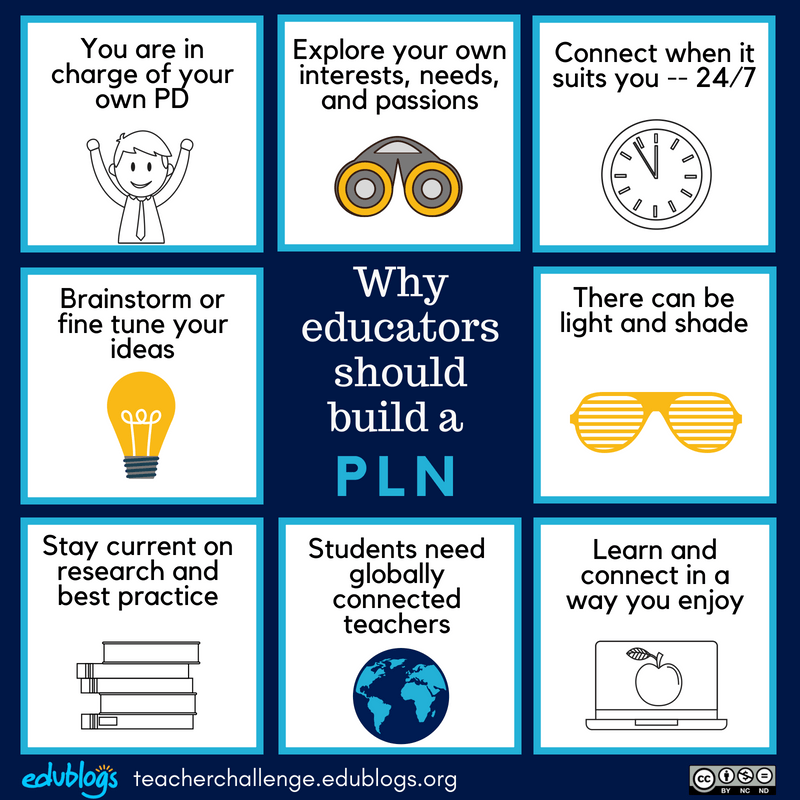
Here are eight benefits of having a PLN:
- You are in charge of your own professional development. PD is no longer something that you have to “sit and get”.
- You can explore your own interests, needs, and passions (or your students’). You might have a student who is struggling with reading, or you might have heard of makerspaces and decide you want to learn more about that, maybe you have a student who wants to research global warming, or perhaps you want to find a better system for running a sports day at your school. You can turn to your PLN for advice and support with all these sorts of things.
- 24/7 learning offers the flexibility to learn and connect at a time that suits you. You don’t have to wait for a PD or conference. And 24/7 learning certainly doesn’t mean you have to be constantly online either — you decide how much time you want to invest and when.
- You can learn and connect in a way that you enjoy. This might be via videos, podcasts, text, social media, Skype, blogging … the list goes on.
- There can be light and shade to your PLN. You can engage in a general chat about education (or anything) to debrief, laugh, or unwind. Or, you can engage in deep discussion, debate, and reflection that can really challenge and transform your thinking and teaching. The choice is yours and there will probably be a time and place for both.
- You can stay current on research and best practice, regardless of whether this information is being discussed in your own school, district (or even country!).
- A PLN allows for broad brainstorming or fine tuning. You might know very little about a certain topic and ask your PLN for any/all entry points into exploring the concept. At the other end of the spectrum, you may have already done a lot of work on a topic and use your PLN to fine tune your ideas and resources.
- Globally connected students need globally connected teachers. Having your own PLN is a key way to also help your students connect with others and start developing their own networks. We know this is important to enrich student learning and help students thrive in the changing labor market.
Feel free to use the following graphic on your blog or share it with your colleagues.
Four Big Ideas Around The Connected Educator
Silvia Tolisana (aka Langwitches) has written about four big ideas that surface when thinking about connected educators.
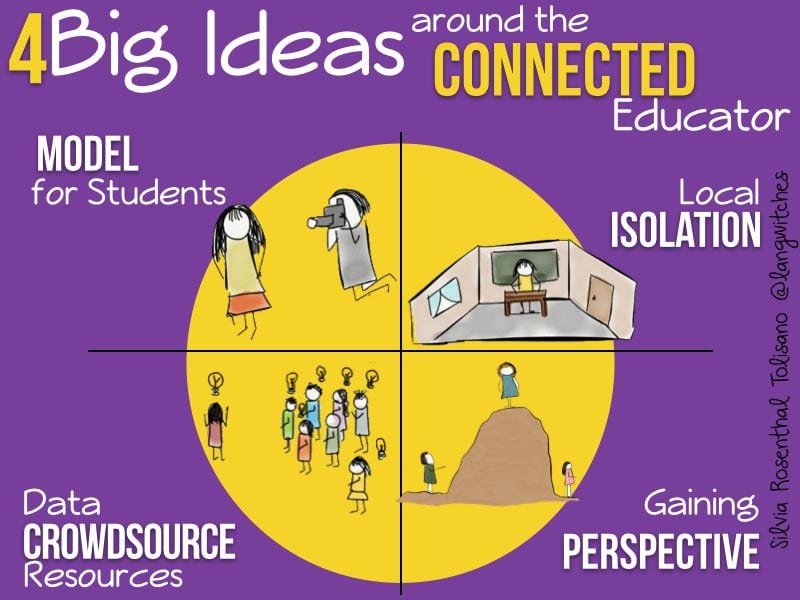
I think about the isolation of a teacher within their classroom walls and how connectedness to a global network of experts and peers could expose and add multiple perspectives to their world view and professional practice.
I am amazed every time by the transformative nature of teaching and learning, when harnessing the power of a network to crowdsource authentic data, resources, connections and collaborators.
Last, but not least, the idea of being able to model for our students what connected learning in an interconnected world means is a moral imperative for educators who are charged to prepare our kids for their future.
You can unpack these concepts further by reading Silvia’s post.
Building Your Own PLN
The great thing about a PLN is that it’s personal!
You make all the choices:
- What tools you use!
- Who you connect with!
- How you want to learn!
- When you want to learn!
The idea of this series is to guide you through the process of building your own PLN and give you a taste of the opportunities that are out there.
Remember, we each have our own preference of what online tools work best for us.
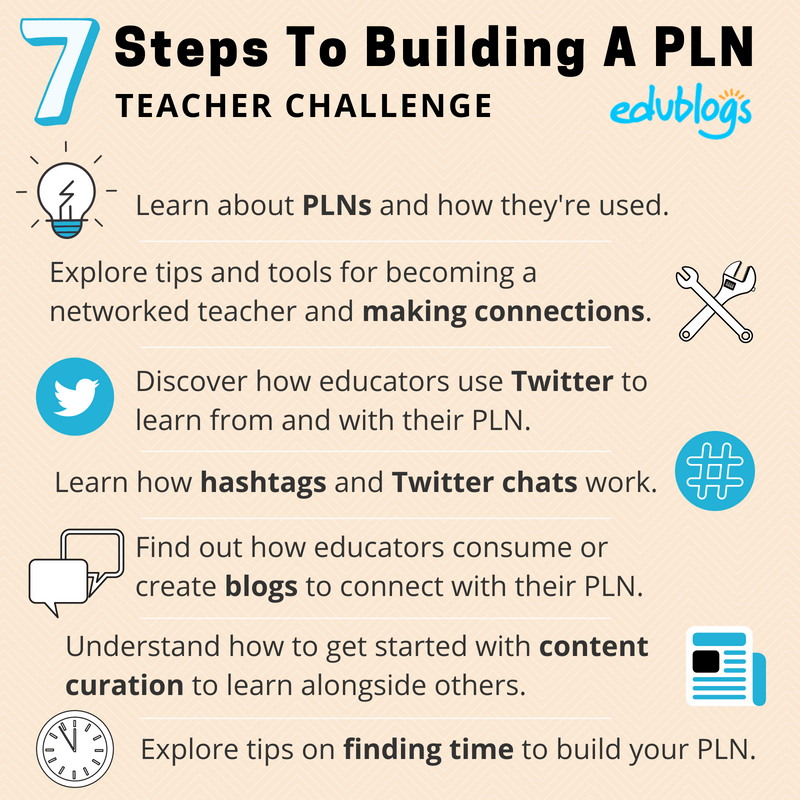
Throughout the seven part series, we’ve included popular tools for building a PLN to help get you started.
Conclusion
A PLN is a network of people and resources that support ongoing learning.
We believe all teachers could benefit from having a PLN.
You might be in a fantastic school but in some ways, schools can become echo chambers for the same beliefs and viewpoints. It can be easy to go with the status quo and fail to really question things or bring in new ideas. A simple conversation with someone from a very different community can be so eye opening.
Your Task
PLNs are all about sharing, collaborating, and learning from each other. So here’s your chance to ask a question, comment, and get involved!
We’d like you to add your voice and ideas to our ongoing conversation about PLNs by undertaking one or more of these challenges:
- PLN Definition: Watch the video What Is A PLN? Leave a comment on this post to explain what a PLN means to you. You might like to share your thoughts on “lurking”. What are the pros and cons of this approach? Or, you might like to explain what you think PLN stands for — personal, professional, personalized … or something else?
- PLN Benefits: Choose one or more of the eight benefits of having a PLN that’s listed above to explore in a comment. Tell us why this is a benefit that resonates with you.
- Connected Educators: Watch the Connected Educators video. Leave a comment on this post to explain why it’s important to be a connected educator and how a PLN can help you. You might like to give an example of one person in the education community that you’d like to follow and learn from or with. This could be a thought leader, or just someone you find interesting.
- Go Deeper: Write a blog post to explain what you have learned about PLNs. Perhaps your post could be a way to educate or persuade others on the benefits of PLNs. Or you might like to summarize some of the information from this study on PLNs for teachers. Leave a comment with a link to the post so we can have a look at how you went.
Also feel free to leave a comment to ask any questions or share your tips.
How to leave a comment: Scroll down to find the comment box. Write your comment, then enter your name and email address (email addresses are not published). Enter the anti-spam word. Press submit and we will moderate your comment ASAP.
The following information on PLNs was adapted from an original Teacher Challenge post by Australian teacher, Michael Graffin. You can check out Michael’s original post — What The heck Is A PLN.
This resource was updated by Kathleen Morris in 2018.
1,446 comments on “Step 1: What Is A PLN?”
A PLN is an easy way to get PD on my own terms and provides more resources. I am able to discuss, and be inspired by other adults in my field and outside of my field. It helps me to grow in what I’m doing and constantly feel like I have people I can turn to when I need help or support.
The PLN that resonates with me is being able to explore interest of students who are struggling readers. I have a student who is struggling with reading and this would be a great benefit to them being able to find something of interest for them to read,
PLN or (Personal/Professional/Personalized Learning Network) is the most powerful thing you can do to improve your teaching and provide better outcomes for your students. It is a self paced PD, that you are incharge of what you want to learn more about! This PD is available 24/7 and readily available at the tips of your fingers.
Some pros of this approach are that now through technology we have access to connect with people who have certain shared interests or career paths as us. It is a great way to increase your learning and communication skills to continue to grow in that specific field. I enjoyed the part of the video where they talked about how you do not have to overconsume to be connected it is personalizable to each individual.
I think PLN is a way to access what I need and share what others might need 24/7. It works around our schedule which is so important with the majority of our time as educators being managed time. It provides a way for teachers and other educators to stay in the now instead of being 4 steps behind everyone else.
Personal and Practical! Wanting to always stay “linked” or “connected” with others in my field helps me structure my professional development needs, daily! Literally at my fingertips, in the vary moments that I might need resources, a voice, or even humor to what daily life is like as a teacher!
I would say number 2 and 7 in the eight benefits of having a PLN resonated the most with me because I believe that community is something vital to a teachers’ wellbeing. I feel teaching has an individualism issue as in teachers believe they need to be able to handle everything on their own always. I feel that being able to access sources and other teachers globally and listen to whats worked best for them makes teaching less overwhelming to the teacher. It also may give especially younger educators a sense of belonging that they don’t already feel they have this early in their field.
The benefit that resonates with me the most is number 6 – you can stay current. This is critical because staying up to date with various research and practice is extremely beneficial in the education industry. Having this benefits promotes validation, factual information, and inclusive teaching. As educators it is our duty to promote accurate and true information to our students.
I watched the video about PLN’s. PLN’s are excellent because it allows you to choose who is a part of your group. It is all about networking with others as well as being able to collaborate with others.
The benefit of a PLN that resonated with me is: “you can stay current on research and best practice, regardless of whether this information is being discussed in your own school, district (or even country!)”. I like that a PLN expands your reach of knowledge. When your network of knowledge is wider, you’re know-how is more up-to-date, which is an important part of being an educator.
I appreciate the idea of being able to connect when it works for me. I find that I often work on things late at night and having a network that can meet those needs is important. If it is not available when I need it, I won’t use it.
A PLN is a beautiful resource for anyone who benefits from networking. Its ability to lurk, share, and explore is excellent and provides flexibility for all. As a future educator, I am certainly interested in joining a PLN and engaging with others in the education community. Regarding the meaning of PLN, I see it as a professional learning network because most people’s interests seem to be in learning and business.
i like that PLN allows me to stay current in my learning in a way that makes me more inclined to learn.
You are in charge of your own professional development. PD is no longer something that you have to “sit and get”.
This is something I agree 100%. I always enjoy being in charge of my own learning and development. Honestly, from all of the PD I personally choose to participate in, it has been more beneficial to me than college courses I have taken in the past.
The first benefit of having a PLN that resonated with me is being able to stay current on research and best practice. Especially as a college student, I feel like there is a disconnect between the School of Education and what is actually happening within schools. Being able to know what is up and coming in research will benefit me once I am in a school. I also really like that PLNs allow teachers to explore their own interests and needs. What is best for my teaching and my students might not be the same for other teachers so being able to find resources to support that need is beneficial.
One of the PLN benefits that resonates most with me is “You can explore your own interests, needs, and passions (or your students’).” I believe that teaching is about doing our best to support our students academic, social, and emotional development, in order to build the most supportive learning community. I want my students to not only thrive, but be engaged with what they are learning, and I believe that a Personal Learning Network is a great tool that can help to foster that. Teachers can communicate with each other — providing guidance, ideas, and new perspectives — which is beneficial when trying to learn how to best support a student and their needs.
A PLN is a personal learning network, which can mean many different things to many different people. The PLN can consist of teachers, students, peers, etc., and can take many alternative forms. Personally, my PLN consists of my professors and peers. I discuss with them the topics that we learn, the ways we can learn topics, and overall, collaborate together.
After reading the article I have a better idea of PLNs and their importance. I like how PLNs allow teachers and future educators teach each other new ideas to keep to to date with current trends and information. I believe this is important to keep students engaged and make their learning interesting.
PLN to me means teachers support teachers. Without using all of our resources to or own benefit to create a safe community inside our classroom, there would be no point.
PLNs are a great way to share information from different sources. Having PLNs allows accessibility as well to many entities such as schools, corporations and organizations. It is a great way to further personal learning and help foster relationships and communications with the entities that share information.
Task 2: One benefit of having a Personal Learning Network (PLN) that resonates with me is 24/7 learning, which offers the flexibility to learn and connect at my own convenience. This aspect allows me to explore new topics and strategies outside traditional professional development sessions, enabling a more personalized approach to my growth as an educator. I can choose when and how to engage, making it easier to balance my learning with my busy schedule. This flexibility empowers me to pursue my interests and adapt to my students’ needs in real-time, ultimately enhancing my teaching effectiveness.
The ability to adjust the dial on levity/seriousness is a powerful benefit of PLNs, in part because it lends itself well to adjustments when our stress loads are heavier or lighter – we can plan the deeper dives for moments when we have the resources for them.
The benefit that resonates with me the most is that you can stay current with the research available in education. The more relevant research that teachers learn, the more likely they will use the best techniques for their classroom. Using a PLN makes this a lot easier, because a group of teachers can communicate about the research and what works well with their classrooms.
Task 2: One benefit of having a Personal Learning Network (PLN) that resonates with me is 24/7 learning, which offers the flexibility to learn and connect at my own convenience. This aspect allows me to explore new topics and strategies outside traditional professional development sessions, enabling a more personalized approach to my growth as an educator. I can choose when and how to engage, making it easier to balance my learning with my busy schedule. This flexibility empowers me to pursue my interests and adapt to my students’ needs in real-time, ultimately enhancing my teaching effectiveness.
The benefit that resonates the most with me is “You can explore your own interests, needs, and passions (or your students’) because I believe it is the most in-tune with my values as a teacher. I believe that the whole point of teaching is to do the best we can to help support our students, both academically and emotionally. A PLN acts as another resource to bounce ideas off of and gather another perspective/opinion. This can be useful academically because you are able to get more ideas/expertise about topics that interest you/your students. Emotionally, you get access to more support and resources to offer students who may need them/are going through something. Having a PLN is so good for both students and teachers alike because it opens the door for so many more resources that can benefit the classroom environment as a whole.
According to the article “Together we are Better”: Professional Learning Networks for Teachers by Torrey Trust, David Krutka, and Jeffery Carpenter, 71% of their surveyed pool responded that people are a major part of PLNs (Trust et al., 2016). I have to agree. Everything we’ve read in step one points to connecting educators across fields and globally through online technology. No, a PLN is not simply scrolling through a feed and liking a teacher’s video; it is a start. The ideas of others drive us and educate us on the realm of possibilities our career has that maybe we never knew about before. People.
Trust, T., Krutka, D. G., & Carpenter, J. P. (2016). “Together we are better”: Professional learning networks for teachers. Computers & Education, 102, 15-34. https://doi.org/10.1016/j.compedu.2016.06.007
One thing I really relate to in the reasons on why to use a PLN is “to stay current” in my field. Learning about new technology is important, even when my school district is not yet considering it. I enjoy thinking about the pros and cons of new technology and its adaptation, and often my learning helps me introduce new technology to other colleagues, administrators, and ultimately students.
One benefit of PLN that I resonate with is being able to learn and connect in a way that I enjoy. I can sometimes become anxious when meeting and connecting with new people in person. PLN allows connection through the use of technology, which is less intimidating to me.
A PLN is an easy way to get PD 24/7 on my own terms. I am able to search, discuss, and be inspired by other adults in my field and outside of my field. This online community can be curated for me and by me. It helps me to grow in my craft and constantly feel like I have people I can turn to when I need help or support.